
Why successful production systems optimize the serving path – not the model
In this paper: Inference optimization builds on the previous layers to remove unnecessary work and improve production economics.
By the time an LLM reaches production, most engineering teams already know the model works. They've demonstrated the use case, validated the output, and shown that the model can solve the problem. Production introduces a different question: can that same capability be delivered consistently, economically, and at production scale?
Then production arrives. Inference costs continue climbing, GPU utilization remains unexpectedly low, latency becomes inconsistent under load, and infrastructure requirements expand faster than anticipated. The natural response is to add more hardware.
Adding GPUs to an inefficient serving system rarely addresses the actual production constraint. More often, it increases the cost of an already inefficient serving path.
This is where inference optimization becomes the final layer of the serving harness. Unlike the previous layers, inference optimization is not about reorganizing the system. It is about removing unnecessary work from a system that is already architecturally sound. The objective is to reduce cost, latency, and hardware requirements without changing the behavior users depend on.
Serving architecture determines how the system is organized. Memory management ensures GPU memory is used efficiently. Batching converts available memory into productive work. Inference optimization asks a different question:
How do you reduce cost, latency, and hardware requirements while preserving the behavior that made the model valuable in the first place?
For many production deployments, improving production economics depends less on replacing the model than on improving the serving path around it.
EXL Engineering Field Guide: Engineering the Harness Series
Moving an LLM from proof of concept to production changes the engineering problem. Model accuracy still matters, but production success increasingly depends on the model’s serving harness: the architecture, memory management, scheduling, and optimization decisions that determine latency, throughput, GPU utilization, scalability, and cost.
This five-part field guide examines those engineering layers as one interconnected system and discusses the tradeoffs engineering teams must make to build LLM applications that perform reliably and economically at scale.
Explore the field guide
Moving an LLM from proof of concept to production changes the engineering problem. Model accuracy still matters, but production success increasingly depends on the model’s serving harness: the architecture, memory management, scheduling, and optimization decisions that determine latency, throughput, GPU utilization, scalability, and cost.
This five-part field guide examines those engineering layers as one interconnected system and discusses the tradeoffs engineering teams must make to build LLM applications that perform reliably and economically at scale.
Explore the field guide
Measure before you optimize
One of the most common mistakes in production AI is applying optimization techniques before understanding the actual bottleneck. Inference optimization isn't a checklist. It's a diagnostic process. Before changing anything, engineers need to understand what the system is already doing.
Optimization without measurement simply changes the system. It does not necessarily improve it. Ask:
- Is GPU memory exhausted?
- Is memory bandwidth limiting decode performance?
- Are latency SLOs being violated?
- Is throughput constrained by scheduling rather than compute?
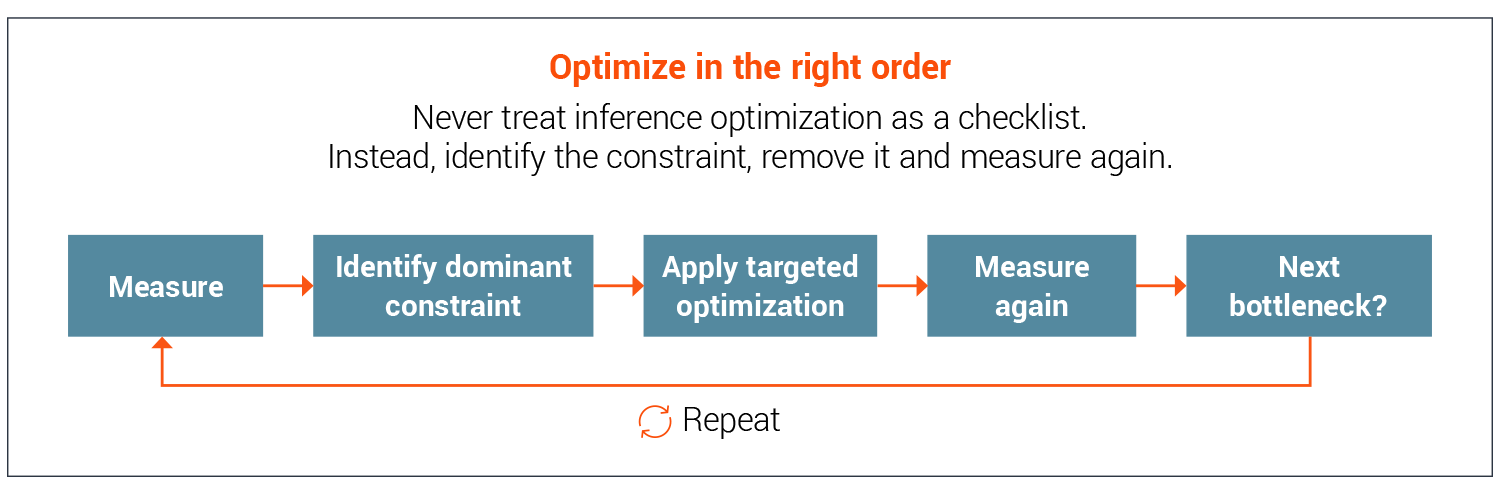
Without those measurements, optimization becomes guesswork. The objective is not to apply every available optimization. It's to identify the production constraint, remove it, measure the result, and then determine whether another optimization is justified.
Quantization removes unnecessary cost
Once the bottleneck is understood, quantization is often one of the first optimizations worth considering.
Running inference in full precision consumes more memory, more memory bandwidth, and more energy than many production workloads require.
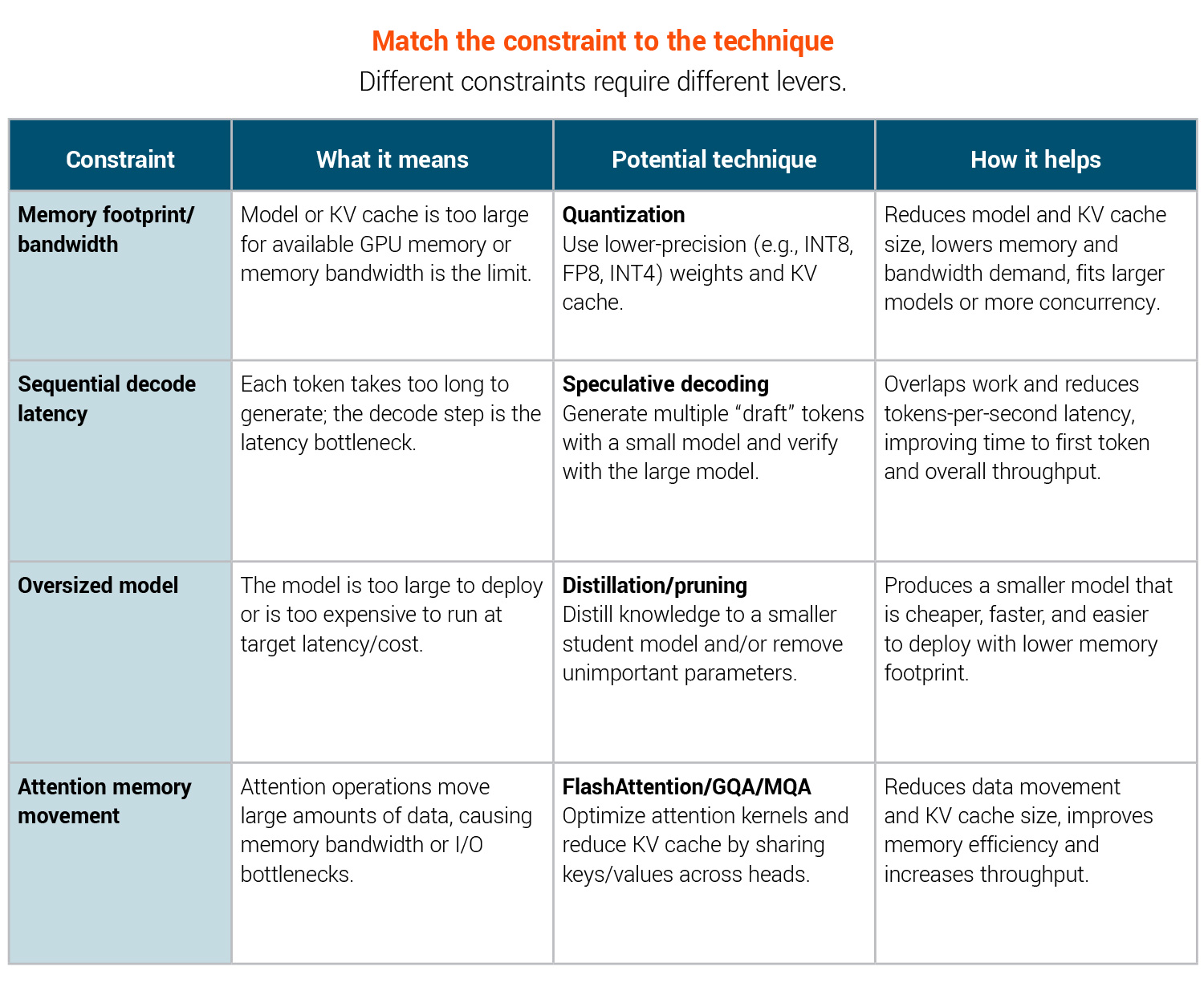
Weight-only quantization reduces that footprint while preserving nearly the same model behavior for many applications. If memory bandwidth is limiting throughput, reducing precision removes unnecessary data movement. If GPU memory is limiting concurrency, the same optimization increases the number of requests that can be served simultaneously.
Deployments that previously required four GPUs may fit comfortably on two. Memory bandwidth improves, infrastructure costs fall, and the same hardware supports more useful work.
Quantization is also not an all-or-nothing decision. Different precision formats introduce different tradeoffs, and those tradeoffs should be evaluated against the workload rather than applied universally.
Different precision formats introduce different tradeoffs, and those tradeoffs should be validated against the workload before deployment. The objective is not to achieve the smallest possible model. It's to remove unnecessary precision while preserving the quality users actually experience.
Reducing latency without changing model behavior
Optimization techniques reduce latency by simplifying the model. Speculative decoding takes a different approach. Instead of changing the target model, a smaller draft model predicts several tokens ahead. The larger model then verifies those predictions in a single pass. When the predictions are accepted, multiple decoding steps are completed at once.
The important point is that the optimization preserves the output distribution while reducing the amount of sequential work required to produce it. Because the target model still validates every accepted token, speculative decoding improves latency without changing the model's final output.
Smaller models are another engineering tool
Not every optimization preserves the original model. Sometimes the workload simply doesn't require the largest available model. Knowledge distillation transfers the behavior of a larger teacher model into a smaller student model designed specifically for production deployment. Pruning removes parameters that contribute little to the final prediction, reducing computational overhead while maintaining acceptable accuracy. Neither technique exists simply to create smaller models.
They exist because many production workloads do not require every capability the largest frontier models provide. The goal is to preserve the capabilities the application depends on while eliminating computation that delivers little practical value.
As with every layer of the serving harness, the workload – not the benchmark – determines the right tradeoff.
Sometimes the model isn't the bottleneck
Optimization extends beyond the model. This distinction matters because not every optimization changes the model. Some improve how the GPU executes the workload. Others improve how efficiently data moves through the system. Both kinds can deliver substantial production gains without affecting application behavior.
FlashAttention, grouped-query attention (GQA), and multi-query attention (MQA) improve how the GPU executes the attention mechanism rather than changing what the model predicts.
These techniques reduce unnecessary memory movement, improve memory bandwidth utilization, and lower the cost of long-context inference.
The optimization targets the serving path rather than the model itself. That distinction captures an important theme throughout this series. Many of the largest production gains come from improving how the model is served rather than changing the model.
Pull quote
"Optimization is not about accumulating techniques. It is about systematically removing the highest-impact bottleneck while preserving the application's production objectives."
Optimize in the right order
Inference optimization is most effective when each technique builds on a stable serving foundation. Applying quantization before solving memory fragmentation rarely produces the expected benefit. Adding speculative decoding to an inefficient batching strategy often leaves significant performance untapped. Likewise, purchasing additional GPUs before understanding the actual bottleneck frequently increases cost without meaningfully improving throughput or latency.
Every optimization assumes that the previous production constraint has already been addressed. Quantization cannot recover performance lost to inefficient batching. Speculative decoding cannot compensate for poor memory management. Additional GPUs cannot compensate for an architecture that was never designed for the workload.
Start by measuring production behavior. Identify the dominant constraint. Apply the optimization that directly addresses that constraint. Measure again. Repeat only if another bottleneck emerges. Optimization is not about accumulating techniques. It is about systematically removing the highest-impact bottleneck while preserving the application's production objectives.
The serving harness is the competitive advantage
Every frontier model available today will eventually be replaced by something better. That reality is why the serving harness becomes the enduring engineering investment. Models will continue to improve. The serving harness is what allows an organization to adopt those improvements without rebuilding the entire production system.
Organizations that consistently succeed in production don't win because they selected the perfect model. They win because they built a serving harness that allows models, hardware, and optimization techniques to evolve without requiring the entire system to be redesigned.
That engineering discipline – not the benchmark score of today's model – is what ultimately determines whether AI becomes an economical production capability.
Looking back
This series began with a simple premise: the model isn't the moat. Serving architecture determines how the system scales. Memory management determines how efficiently it uses resources. Batching determines how effectively those resources perform useful work. Inference optimization ensures that every layer operates at the lowest practical cost while satisfying the application's service-level objectives. Together, they form the serving harness.
Models will continue to evolve. New optimization techniques will continue to emerge. Production engineering will continue to change with them. Organizations that invest in the serving harness will be able to adopt those advances systematically rather than redesigning their production systems each time the model changes.
The serving harness should be treated as a system, not a collection of independent optimizations. As workloads, models, and infrastructure change, return to the papers in this five-part Engineering the Harness white paper series to identify where the next constraint may emerge. The durable advantage isn't any single optimization. It's an engineering discipline that makes the entire inference system easier to measure, adapt, and improve.