
Most enterprises are seeking to govern their data consistently across platforms that were never designed to share rules. A warehouse for finance reporting, a data lake for data science, a software-as-a-service (SaaS) analytics tool for marketing: each one arrives with its own catalog, its own access model, and its own idea of who owns what.
The scale of the problem is visible in EXL’s own research. According to EXL’s 2026 Enterprise AI Study, only 30% of organizations say their data is available enterprise-wide, and the rest struggle with varying levels of data silos. The same customer table often exists in several places with different access policies, and nobody can say with confidence which copy is the source of truth.
1. The hidden cost of fragmented catalogs
Data teams historically deployed separate systems: data warehouses for structured analytics and data lakes for unstructured exploration. Each system kept its own proprietary catalog and governance model, so data ended up in isolated silos.
For data engineers, data operations professionals, and analysts, this means duplicating access policies, taking on compliance risk, and struggling to keep one version of the truth. The costs show up in four places:
Duplicated effort: every access rule must be defined, tested and maintained once per platform.
Policy drift: copies of the same rule slowly diverge, and one of them quietly becomes the weakest link.
Audit exposure: answering “who accessed this data, and when?” means stitching together logs from several systems.
Slower AI: models and agents need governed, discoverable data. When teams cannot find or trust data, AI projects stall before they reach production.
Databricks frames the same problem from the security side: historically, row- and column-level controls were enforced inside a single engine, but in an open data platform the same table can be accessed by many engines, so governance needs to work everywhere the data can be accessed.
2. What an open, unified platform changes
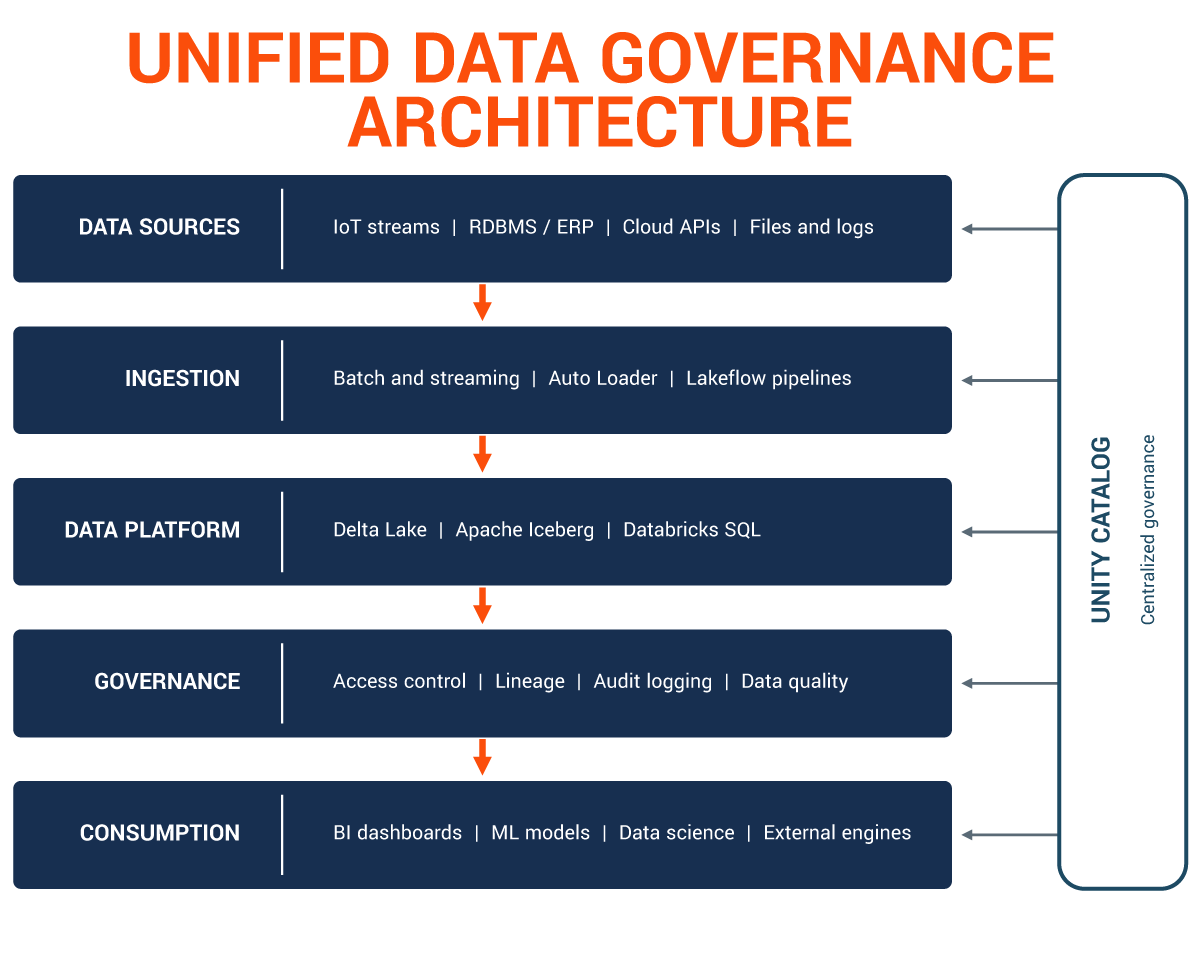
An open data architecture combines the scalable, low-cost storage of data lakes with the management features of data warehouses. Data sits in open table formats such as Delta Lake and Apache Iceberg, which many engines can read, so the organization no longer has to copy data into each tool.
That openness creates a new requirement: governance must work everywhere the data can be accessed, not only inside one engine. A central catalog, such as Databricks Unity Catalog, makes this possible by defining access, lineage and audit once for data and AI assets. In June 2026, Databricks reported that more than 14,000 organizations now govern their data and AI on Unity Catalog.
3. What good governance means: the DAMA-DMBOK view
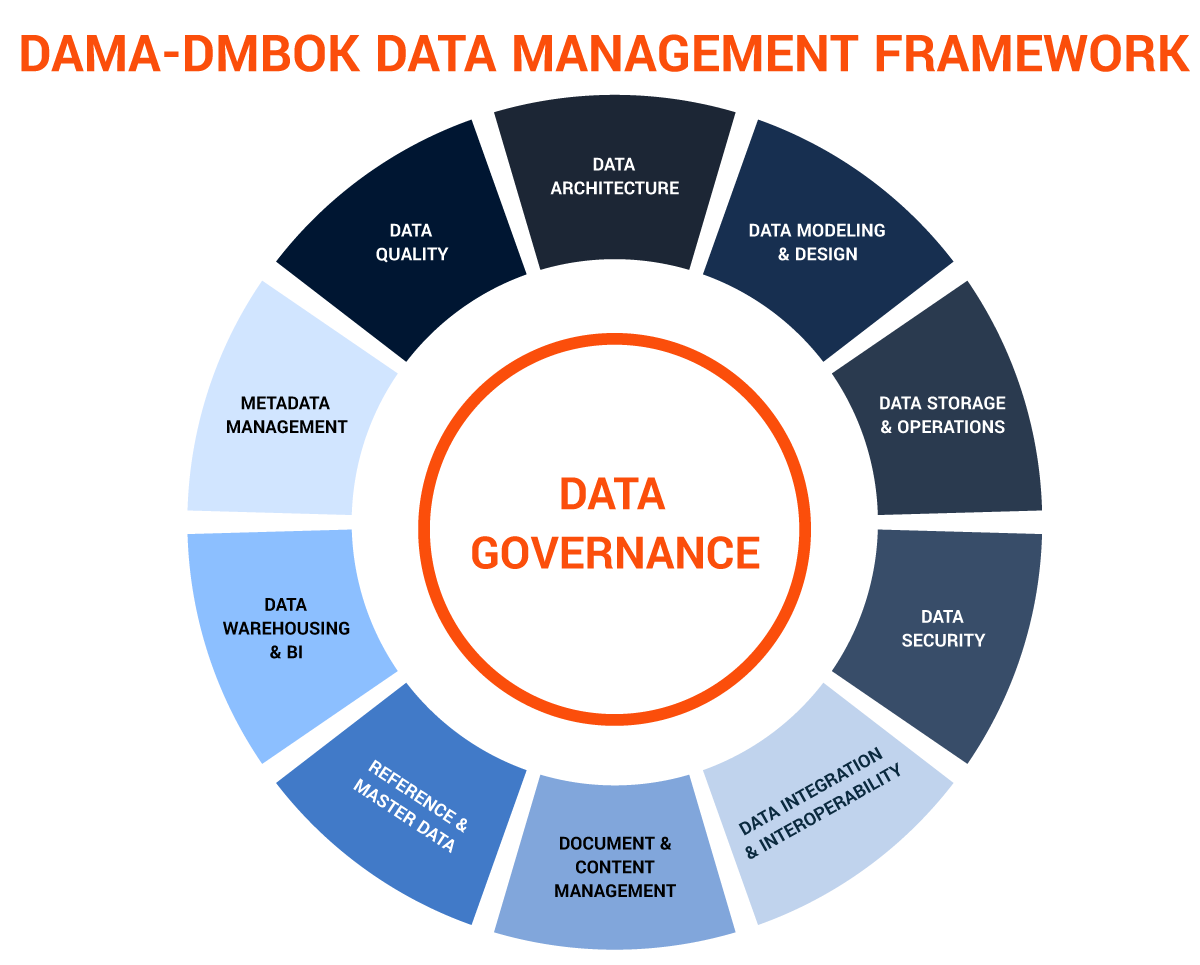
To ground this in an established industry standard, we turn to the Data Management Body of Knowledge (DAMA-DMBOK)1. It defines data governance as, “the exercise of authority and control (planning, monitoring, and enforcement) over the management of data assets.” In practice, governance is the framework that keeps data secure, accurate and available to the right people at the right time.
The DAMA framework places data governance at the center of the DAMA Wheel, connected to ten other knowledge areas, including data architecture, data security and data quality. The DMBOK notes that organizations with a formal governance program “exercise authority and control with greater intentionality” and are “better able to increase the value they get from their data assets.”1
One knowledge area matters especially for a unified data platform. DAMA describes data integration and interoperability (DII) as “processes related to the movement and consolidation of data within and between data stores, applications and organizations”1. Modern open data architectures are designed to deliver exactly this without making extra copies.
4. The EXL perspective: governance is an operating model, not a tool
The DMBOK makes a point that is easy to lose in platform discussions: “Data Governance is a business program” and “a shared responsibility between business data stewards and technical data management professionals”1. A unified catalog gives you one place to enforce decisions. It does not make those decisions for you.
EXL perspective
Organizations get lasting value from a unified catalog when they treat it as the technical backbone of a broader operating model, one that combines:
Clear ownership: named data owners and stewards for each business domain, not only platform administrators.
Policy by principle: access rules written from business principles (for example, “sensitive health data is masked unless there is a documented business need”) and then turned into technical policies.
Domain context: knowing which data elements are regulated, sensitive, or business-critical in insurance, healthcare, banking, and other industries.
Technology unifies enforcement. The operating model makes the enforcement right. Part three shows how EXL puts this into practice for clients.
Key takeaways
Fragmented catalogs create duplicated effort, policy drift, audit exposure, and slower AI adoption.
An open data platform removes the need to copy data into each tool, but only if governance follows the data to every engine.
DAMA-DMBOK frames governance as a business program with shared responsibility. This is the lens for choosing and implementing a platform.
Next in the series: how open application programming interfaces (APIs), catalog federation, and cross-engine access control work in practice, and how to choose the right enforcement pattern.
References
[1] DAMA International. (2017). DAMA-DMBOK: Data Management Body of Knowledge (2nd ed.). Technics Publications. Chapter 3, Data Governance; Chapter 8, Data Integration and Interoperability.