Making unified governance real: where EXL fits
From platform capability to a governance program that lasts

Intro
Parts one and two of this series covered the why and the how: fragmented governance is costly, and open catalogs, federation, and cross-engine policies can now unify it. This final part covers the question leaders ask most often: how do we actually get there, and how do we know it is working?
Why technology alone does not deliver governance
A unified catalog gives an organization one place to enforce access, lineage and audit. But the Data Management Body of Knowledge (DAMA-DMBOK) reminds us that data governance is a business program that “must govern IT decisions related to data as much as it governs business interaction with data”1. The DMBOK also stresses that implementing a governance program “requires commitment to change”1.
In practice, programs stall for reasons that have little to do with the platform: unclear data ownership, legacy code nobody has documented, policies that cannot be traced back to a business rule, migrations that stop halfway, and no way to show leadership the value delivered. Closing those gaps takes data and AI engineering combined with deep industry and operations knowledge.
“Enterprise AI depends on reliable data, deep business context and trusted execution.”
Anand “Andy” Logani, Executive Vice President and Chief AI Officer, EXL
How EXL fits into the equation
EXL brings three things to a data governance program:
- A deep Databricks partnership. In June 2026, EXL achieved Gold Tier status in the Databricks Partner Program, expanding its collaboration with Databricks to help organizations strengthen their data foundations for enterprise AI.
- AI-native delivery assets. EXLdata.ai, launched in partnership with Databricks, is a multi-agent data solution whose purpose-built agents autonomously manage discovery, migration, engineering, governance, annotation, labeling, and operations across the entire data lifecycle. Working with Databricks Unity Catalog, it transforms manual, error-prone governance into a dynamic, real-time process. EXL’s Code Harbor™ applies AI agents to migrating legacy code, such as SAS, to Databricks.
- Governance across platforms, not only inside one. EXL helps enterprises adopt Databricks Bring Your Own Lineage capabilities, extending end-to-end lineage, governance, and auditability across distributed environments, particularly in regulated industries such as insurance, banking, and healthcare.
A phased approach
EXL helps organizations transform their approach to data governance through five defined stages.
A PHASED APPROACH TO DATA GOVERNANCE DELIVERY
From governance strategy to governed day-to-day operations
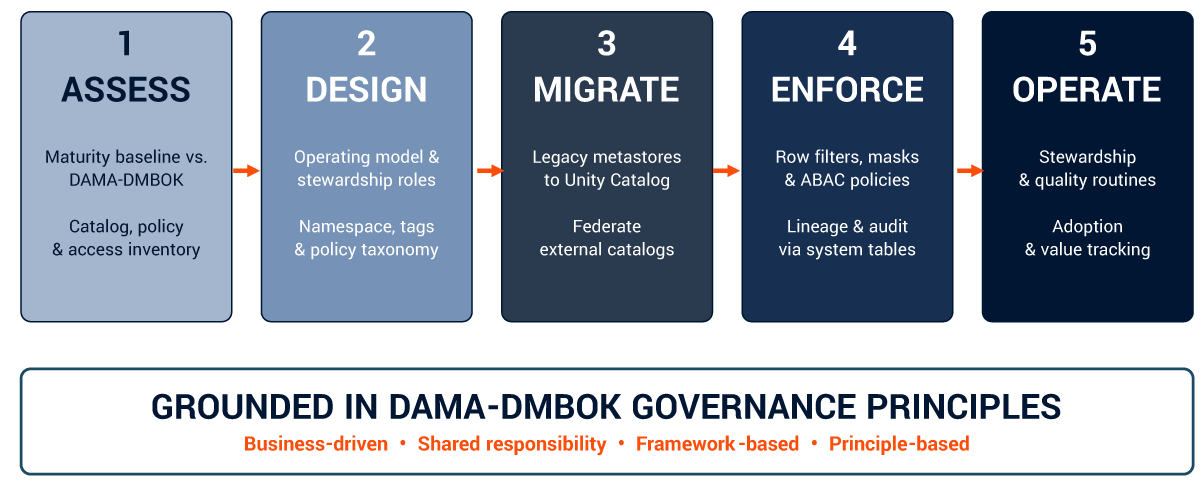
Figure 5: A phased approach to data governance delivery
- Assess: baseline governance maturity against the DAMA-DMBOK knowledge areas, and inventory existing catalogs, access policies, and regulated data.
- Design: define the operating model (data owners, stewards, decision rights), the Unity Catalog namespace, and a tag and policy taxonomy based on business principles.
- Migrate: move legacy platforms, code, and metastores to Databricks step by step. Catalog federation for Hive Metastore and AWS Glue is designed for exactly this kind of incremental migration.
- Enforce: put row filters, column masks, and attribute-based access control (ABAC) policies in place, and use Unity Catalog system tables for audit and lineage reporting.
- Operate: set up stewardship routines, data quality monitoring, and adoption tracking so governance keeps pace with the business.
The approach draws directly on four of the governance principles set out in the DAMA-DMBOK: business-driven, shared responsibility, framework-based, and principle-based1.
EXL client stories
Two published EXL engagements show what this looks like in practice. Both are in insurance, one of the highly regulated industries where EXL helps clients strengthen trust, compliance and operational resilience.
A global specialty insurer: two cloud platforms consolidated into one governed Databricks platform
| Challenge | The insurer ran a complex environment spread across two separate cloud data platforms. |
| What EXL did | EXL consolidated the two platforms into a single, scalable Databricks platform. The work followed a step-by-step migration strategy that began with a proof of concept to validate the move. The new platform uses Unity Catalog for improved data governance, together with Databricks capabilities such as liquid clustering and predictive optimization. |
| Outcome | The insurer simplified operations, reduced costs and boosted performance. Reported results include a reduced data workload, cost savings, better compliance and simplified maintenance, achieved in just four months. |
A leading insurance provider: legacy SAS code migrated to Databricks, with governance built in
| Challenge | The provider was moving its data warehouse to Databricks, but a significant portion of its SAS code contained embedded Oracle SQL. Tens of thousands of lines needed refactoring, and limited documentation plus the lack of structured data lineage made debugging and validation difficult. |
| What EXL did | EXL used its Code Harbor™ multi-agent solution to migrate the SAS code to PySpark, with over 64 data tables accurately converted. The solution automatically generated a data catalog with schema and lineage mapping, tested the migrated code on synthetic data, and supported user acceptance testing (UAT) and reconciliation in the client’s environment. |
| Outcome | 50% efficiency improvement in code migration, 50% reduction in UAT and reconciliation effort, and enhanced data governance, standardized documentation and improved audit readiness. |
The common thread: in both engagements, governance was not an add-on at the end. Cataloging, lineage and Unity Catalog governance were built into the migration itself.
DAMA-DMBOK in practice, beyond any single platform
The same discipline shows up in EXL engagements on other platforms and in other industries. Each example below maps to a DAMA-DMBOK knowledge area1:
| DAMA-DMBOK area | Published EXL engagement | Reported outcome |
|---|---|---|
| Data quality: “the fitness of data for use”1 | NAES, a global energy services firm: EXL’s agentic AI solution, built with Microsoft Power Platform, matched invoice line items to supporting documents with a confidence score and full audit trail, while quality control agents flagged anomalies early in the process. | 85%+ auto-matching rate and a 50%+ reduction in invoice processing time, with real-time quality control and root-cause analysis that reduced repeat errors. Read the full case study. |
| Metadata: including “data flows” (lineage)1 | A leading bank: EXL’s Code Harbor™ traced table and variable lineage across legacy code and built standardized data dictionaries. | 70% faster identification of data lineage, with more comprehensive regulatory reporting. Read the full case study. |
| Data security | Digital Federal Credit Union (DCU): EXL helped define the data strategy and governance for DCU’s cloud data platform, including metadata-driven ingestion and privacy settings that share information across platforms based on the sensitivity of the data. | Within six months, DCU’s IT team migrated 30 months of data, over 5.8 billion documents, to Amazon Redshift for analysis, with the data refreshed each night. Read the full case study. |
Across platforms, the pattern is the same as in the two Databricks engagements above: governance works when it is built into how data is created, moved, and reported. Unity Catalog makes that enforcement simpler on Databricks, and the DAMA-DMBOK keeps the discipline consistent everywhere.
Lessons from the field
A few lessons come up again and again in data governance programs:
- Design the namespace as a governance contract. Deciding early what catalogs, schemas and tags mean avoids expensive rework later.
- Migrate in phases, and validate early. A proof of concept de-risks the move, and catalog federationlets legacy and governed data coexist while teams move over.
- Capture lineage and documentation during migration. Undocumented legacy code is a governance risk in its own right. Generating catalog and lineage as part of the migration makes audit readiness a by-product, not a separate project.
- Write policies on tags, not tables. A single ABAC policy can enforce consistent rules across an entire catalog or schema. Per-table grants do not scale the same way.
- Govern AI assets together with data. Through Unity Gateway, built on Unity Catalog, models, agents, Model Context Protocol (MCP) services and skills can be governed alongside data, with the same access controls, discovery, lineage and auditing.
Measuring success
Governance earns continued investment when it can show results. These are the measures to track from the start:
| Key performance indicator | What it tells you | Where to measure it |
|---|---|---|
| Share of data assets under central governance | How far the migration has progressed | Unity Catalog information schema |
| Access request turnaround | Whether governance speeds the business up or slows it down | Ticketing system and grant history |
| Assets with a named owner and classification | How mature stewardship is | Catalog metadata and governed tags |
| Duplicate datasets and pipelines retired | Cost and complexity removed | Storage and job inventories, including the jobs system tables |
| Audit evidence preparation time | Compliance readiness | Audit log and lineage system tables |
Conclusion: open, secure and interoperable
As data volumes grow and the range of analytical tools expands, organizations can no longer afford fragmented governance. The real cost is becoming the hidden tax of duplicated pipelines, misaligned access policies, and the compliance risk that builds up when there is no single record of who accessed what and when.
When evaluating a governance approach, ask whether it will stay viable as your engines change, not only whether it supports the engine you use today. Choose open formats and open application programming interfaces (APIs) that avoid lock-in, and check where policy enforcement actually happens. Above all, pair the platform with an operating model and a delivery partner that make governance part of every migration, not an afterthought.
Let’s talk
EXL helps organizations design, migrate to and run governed data platforms on Databricks, combining data and AI engineering with deep industry expertise. To discuss your governance roadmap, with the EXL data and AI team.
References
[1] DAMA International. (2017). DAMA-DMBOK: Data Management Body of Knowledge (2nd ed.). Technics Publications. Chapter 3, Data Governance; Chapter 7, Data Security; Chapter 12, Metadata Management; Chapter 13, Data Quality.
[2] EXL Investor Relations. (2026, June 12). EXL achieves Gold Tier status in the Databricks Partner Program and expands collaboration with Databricks. News release.
[3] EXL. EXL unveils EXLdata.ai with launch partner Databricks. EXL newsroom.
[4] EXL. How EXL helped a leading insurance provider migrate SAS to PySpark with 50% efficiency gains. Case study.
[5] EXL. Case study: a global specialty insurer consolidates two cloud data platforms on Databricks.
[6] EXL. Case study: NAES, agentic AI for invoice matching and billing.
[7] EXL. EXL transforms regulatory reporting for a leading bank with Code Harbor. Case study.
[8] EXL. Customer Spotlight: Digital Federal Credit Union (DCU). Case study.
[9] Databricks. Attribute-based access control (ABAC) in Unity Catalog. Databricks documentation (AWS edition).
[10] Databricks. Connect to external databases and catalogs. Databricks documentation (AWS edition).
[11] Databricks. System tables reference. Databricks documentation (AWS edition).
[12] Databricks. Information schema. Databricks documentation (AWS edition).
[13] Databricks. (2026, June 16). What’s new in Unity Catalog at Data + AI Summit 2026 (Unity Gateway). Databricks Blog.
Company results quoted in the client stories are as reported by EXL in the cited case studies. Databricks sources were reviewed in October 2026.







Related articles

Token economics: The hidden system lever behind scalabl...