
2026 EXL Enterprise AI Study | Insurance
AI in insurance: From adoption to lasting advantage
Confidence in AI is outpacing actual performance. See what separates insurers achieving measurable outcomes from those stuck in place, and learn what a stronger AI strategy for insurance companies looks like in practice.
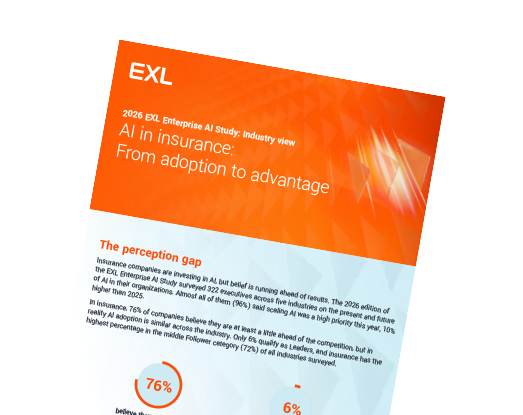
EXL surveyed executives across five industries, including insurance, to find out where AI in the insurance industry is delivering value and where perception is running ahead of reality. This AI in insurance report shows what is driving outcomes today and the factors separating AI leaders from the rest. It also offers clear insurance AI benchmarking, so you can see how your organization compares as AI adoption in insurance accelerates.
92% of insurance executives say their data is a challenge to AI success
What you'll learn about AI in insurance:
EXL surveyed executives across five industries, including insurance, to find out where AI in the insurance industry is delivering value and where perception is running ahead of reality. This AI in insurance report shows what is driving outcomes today and the factors separating AI leaders from the rest. It also offers clear insurance AI benchmarking, so you can see how your organization compares as AI adoption in insurance accelerates.
92% of insurance executives say their data is a challenge to AI success
What you'll learn about AI in insurance:
Frequently asked questions
The most significant insurance AI trends 2026 center on the shift from experimentation to enterprise-wide scale. Scaling AI is now a high priority for 96% of insurers, up 10 percentage points from 2025. Agentic AI is advancing fastest in risk management, actuarial, underwriting, and customer experience, orchestrating complex, end-to-end workflows across multiple systems and roles. Insurers are also moving beyond point solutions toward redesigning full workflows, connecting intake, conversational, and claims steps at FNOL in P&C and unifying data foundations across underwriting and onboarding in L&A.
While 76% of insurers believe they are at least a little ahead of the competition, actual AI adoption in insurance is similar across the industry. Only 6% qualify as Leaders, and insurance holds the highest share of companies in the middle Follower category (72%) of any industry surveyed. Encouragingly, insurers move more AI pilots into production than any other industry: 62% of pilots reach production. The pilots that advance share three traits, a clear business owner, a defined outcome, and agreement on what "production ready" means.
AI in the insurance industry is most mature in customer-facing and operational areas. The leading applications include fraud detection (54%), customer servicing (54%), financial crime compliance/AML/KYC (44%), risk management (44%), and claims (42%). For agentic AI specifically, risk management leads at 54%, followed by actuarial, underwriting, and pricing (46%) and customer experience (45%). Adoption remains less mature in underwriting, actuarial, and risk decisioning, which signals substantial room for deeper AI transformation in insurance.
AI in insurance underwriting delivers measurable operational and financial gains. Nearly half of insurers (46%) have fully deployed AI in actuarial and underwriting, and Leaders generate 40% more revenue growth and 37% more cost reduction than Laggards in the use cases where AI is applied.
Data remains the leading obstacle to enterprise AI in insurance. A striking 92% of insurers say their data is a challenge to AI success, and insurance cites data silos as the top barrier more than any other industry. Confidence in data quality nearly doubled since 2025, yet more than half of insurers now report problems with data efficiency, which raises the cost of running AI. Only 24% consider themselves leading edge on data management maturity, and just 38% completely agree they have sufficient governance for ethical and responsible AI use. Closing these gaps in data readiness and governance is central to a durable AI strategy for insurance companies.